Polymer-derived Chemical Migrants in Food Packaging Systems: Occurrence, Analytical Characterization, Migration Mechanisms and Cancer-Relevant Risk Prioritization
Ekta Sharma
Department of Textiles and Clothing, College of Community Science, C. S. Azad University of Ag. and Tech., Kanpur, Uttar Pradesh, India.
Archana Singh
Department of Textiles and Clothing, College of Community Science, C. S. Azad University of Ag. and Tech., Kanpur, Uttar Pradesh, India.
Sushil Kumar Sharma *
Bureau of Indian Standards, Delhi, India.
*Author to whom correspondence should be addressed.
Abstract
Polymeric food-contact materials are now an essential part of food packaging because they help protect food, extend shelf life, improve handling, and support safe storage and distribution. However, these materials are not chemically inert. They are complex formulated systems that may release residual monomers, oligomers, additives, catalyst residues, coating components, printing-ink chemicals, adhesive-related substances, and non-intentionally added substances into food or food simulants. This review examines polymer-derived chemical migrants in food packaging systems with a focus on their occurrence, analytical characterisation, migration behaviour, and cancer-relevant risk prioritisation. The review covers important polymeric and polymer-containing food-contact materials, including polyethylene terephthalate, polyethylene, polypropylene, polystyrene, polyvinyl chloride, polyamides, polycarbonate, epoxy coatings, multilayer laminates, and coated paper or board systems. Migration is discussed as a chemistry-driven mass-transfer process influenced by polymer structure, molecular size, polarity, crystallinity, free volume, food composition, temperature, contact time, and surface-to-volume ratio. This review also considers the material-science factors that influence chemical migration, particularly polymer microstructure, crystallinity, amorphous-region mobility, oxygen transmission rate, water-vapour transmission rate and water-vapour permeability. Recent developments in bio-based and biodegradable packaging polymers, including PLA, PHA, PBS, starch, cellulose and polyvinyl alcohol-based active films containing plant-derived bioactive compounds, are also included because these materials are increasingly being promoted as sustainable food-packaging alternatives. The review further highlights advanced NIAS identification approaches, including LC-HRMS, suspect screening, ion-mobility HRMS, digital spectral libraries, in silico fragmentation and machine-learning-supported prioritisation, to strengthen the analytical and risk-prioritisation discussion.
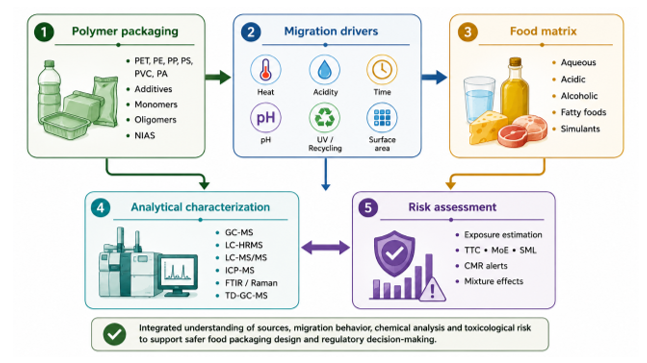
Graphical Abstract: Overview of polymer-derived chemical migrants in food packaging systems, showing major polymer sources, migration drivers, food-matrix interactions, analytical characterization approaches, and cancer-relevant risk-prioritization factors.
Keywords: Food-contact materials, polymer migrants, NIAS, migration kinetics, LC-HRMS, GC-MS, ion-mobility HRMS, biodegradable polymers, polyvinyl alcohol, plant bioactives, computational migration modelling, toxicological prioritisation, cancer-relevant risk, safer-by-design packaging